Updated October 2026
Measure the distance between the centres of the 2 existing screw holes in millimetres, then buy a pull with the same centre-to-centre number. Overall length, screw length and door thickness matter too, but centre-to-centre is the measurement that decides whether the new pull fits the old holes.
Step 1: measure centre-to-centre
Take the old pull off and measure from the middle of 1 hole to the middle of the other, or from the left edge of 1 hole to the left edge of the other; the result is the same. Use a metric tape or rule. Most hardware is made to a metric series, so a reading of 127 or 129 mm means 128 mm. If the old pull is still on the counter, measure between the centres of its 2 threaded posts instead. A knob has 1 hole, so there is nothing to match; any knob fits.
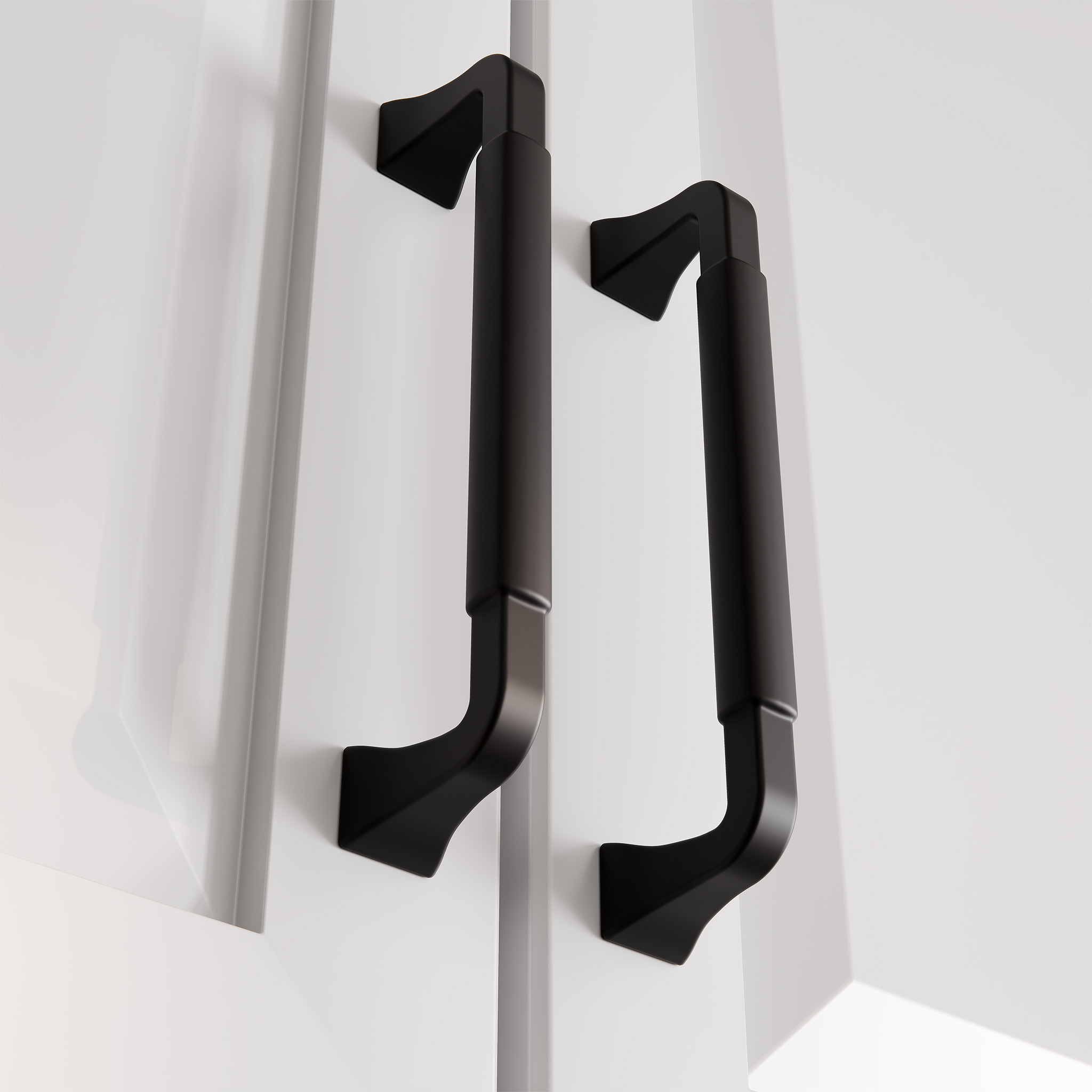
Common centre-to-centre sizes
| Measured | Size to order | Inch equivalent |
|---|---|---|
| 63 to 65 mm | 64 mm | 2 1/2 in |
| 75 to 77 mm | 76 mm | 3 in |
| 95 to 97 mm | 96 mm | 3 3/4 in |
| 127 to 129 mm | 128 mm | 5 in |
| 159 to 161 mm | 160 mm | 6 5/16 in |
| 191 to 193 mm | 192 mm | 7 9/16 in |
| 223 to 225 mm | 224 mm | 8 13/16 in |
| 255 to 257 mm | 256 mm | 10 1/16 in |
| 319 to 321 mm | 320 mm | 12 5/8 in |
Older kitchens often have 76 mm (3 in) or 96 mm holes; newer ones are more often 128 mm or 160 mm.
Step 2: check overall length
Overall length is the tip-to-tip measurement of the pull. 2 pulls with the same centre-to-centre can have quite different overall lengths, which changes how the pull looks on the drawer and whether it clears neighbouring doors, a wall return or an appliance. Check that the new length leaves a comfortable gap to the drawer edge and does not strike the door beside it when either is opened.
Step 3: screws and door thickness
Measure the thickness of the door or drawer front. Most are 18 to 20 mm; some drawer fronts and older doors are 22 to 25 mm. The screw needs to pass through the door and thread 4 to 6 mm into the pull, so a 25 mm screw suits an 18 to 20 mm door and a 30 or 35 mm screw suits thicker fronts. Too short and the pull will not seat; too long and it bottoms out before the pull is tight.
Metric pulls usually take an M4 screw thread. Many pulls made for the US market take an 8-32 thread instead. The 2 are close in diameter but will not interchange, so when a pull arrives with screws, use those, and when you need longer ones, match the thread on the pull rather than reusing old screws from a different brand.
If your size is no longer made
Some older centre-to-centre sizes, and odd sizes from imported kitchens, are hard to find. 4 ways to handle it:
- Backplate. A backplate sits behind a new knob or pull and covers the old holes. Choose one long enough to span both holes with a margin on each side.
- Switch to knobs. Fill 1 hole, finish it and fit a knob in the other. On a painted door the filled hole disappears under a touch-up coat; on stained wood it will show.
- Fill and redrill. Glue a hardwood dowel into each hole or use a 2-part wood filler, sand flush, touch up and drill for the size you want. This is routine when doors are being repainted.
- Choose a pull that covers. A pull with a wide base or a solid bar between the posts can hide old holes inside its footprint, provided the new holes land on solid material.
Converting a door from a knob to a pull means drilling 1 new hole: use the existing knob hole for 1 post and mark the second from it.