Updated October 2026
Both work on any cabinet; the choice comes down to grip, the look you want and the holes already in the doors. The most common arrangement is knobs on doors and pulls on drawers, which gives a light touch on the uprights and a firm, 4-finger grip on the drawers that carry weight.
What each does well
A knob fixes with 1 screw, sits small on the door and is quick to fit. It suits doors, which are light and swing on hinges, and it keeps a busy kitchen looking uncluttered. It also fits where space is tight, such as a narrow stile or a door that meets a wall.
A pull fixes with 2 screws, spreads the load across 2 points and lets the whole hand wrap around it. It suits drawers, which are heavier and are opened straight out, and it suits anyone who prefers not to pinch. A pull also gives a longer line of metal to look at, which is why slab-front kitchens tend to use pulls throughout.
| Knobs | Pulls | |
|---|---|---|
| Screws | 1 | 2 |
| Grip | Fingertips | Whole hand |
| Suits | Doors, small drawers, tight spaces | Drawers, tall doors, heavy fronts |
| Look | Quiet, traditional or cottage | Linear, contemporary or transitional |
| Sizing | By diameter, usually 25 to 38 mm | By centre-to-centre, 64 to 320 mm |
| Snagging | Can catch pockets and belt loops on base cabinets | Vertical pulls on doors can catch sleeves; horizontal pulls on drawers rarely do |
| Replacement | 1 hole, fits any knob | Must match centre-to-centre |
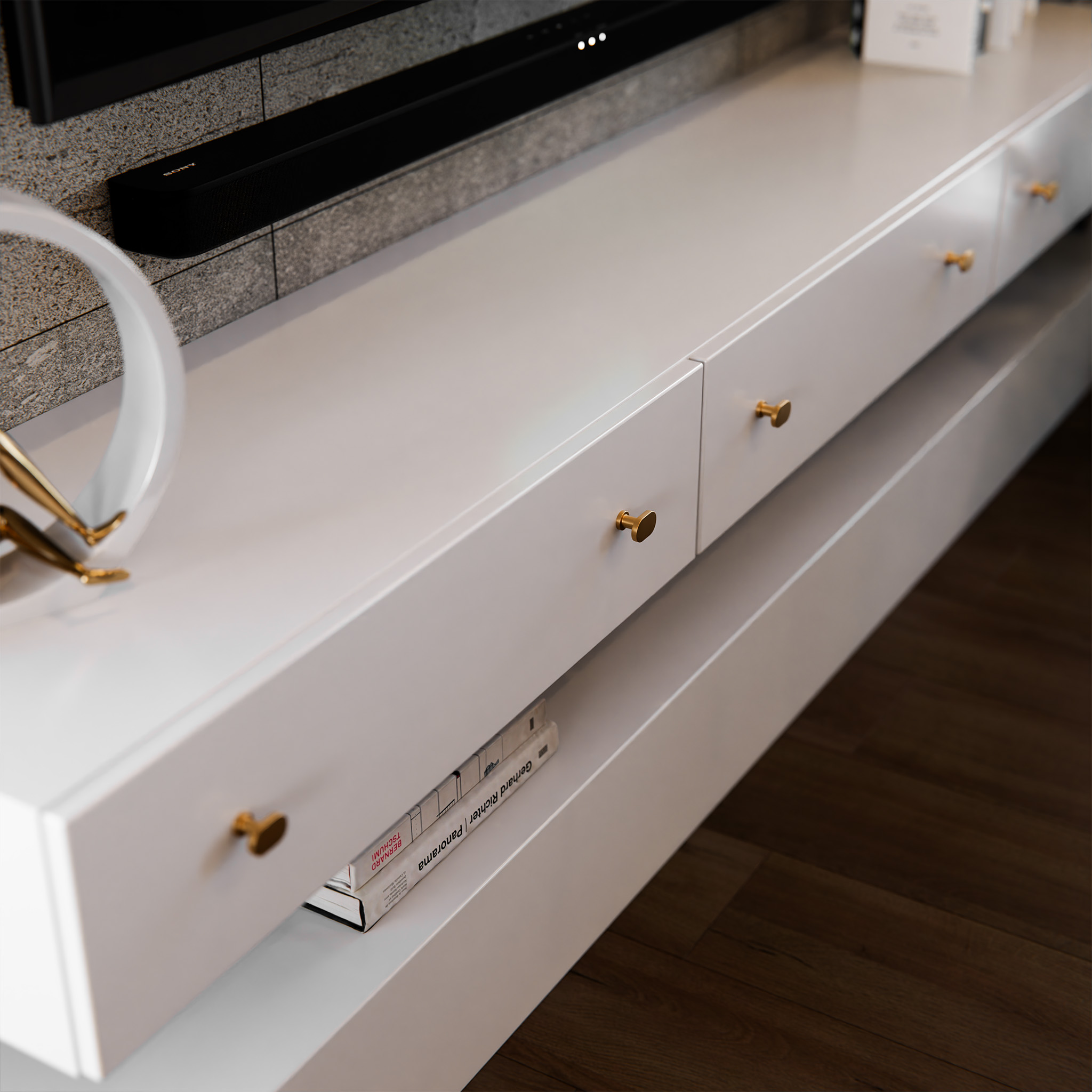
3 common arrangements
- Knobs on doors, pulls on drawers. The usual pairing in transitional and traditional kitchens. Choose the knob and pull from the same collection or at least the same finish so they read as 1 set.
- Pulls everywhere. Clean and continuous, especially on slab or shaker doors painted in 1 colour. Use 1 size for doors and smaller drawers and a longer size for wide drawers.
- Knobs everywhere. Rare in large kitchens but common in small ones, pantries, laundry rooms and bathroom vanities, where fronts are narrow and the small hardware keeps things calm.
Cup pulls, which are open at the bottom and gripped from underneath, are a 4th option for drawers in farmhouse and traditional kitchens, often paired with knobs on the doors.
Decide by how you use the kitchen
- If anyone in the household has arthritis or a weaker grip, choose pulls on everything that gets daily use. A bar pull can be opened with 2 fingers or a hooked hand.
- If you lean on the counter while you cook, horizontal pulls on top drawers are less likely to catch clothing than knobs that stick out 30 mm.
- On a run of doors that meet at an inside corner, a knob on each door clears more easily than 2 pulls that would knock together.
Decide by the doors you have
Existing holes decide a lot. A door with 1 hole takes any knob without filling. A drawer with 2 holes takes any pull that matches the centre-to-centre measurement, or a knob only if the second hole is filled and finished. Painted doors can be filled and touched up; stained wood is harder to hide, so matching the existing hole pattern is the simpler path.
Finish and scale
Whichever you choose, keep the finish the same across the room and keep the scale in proportion: knobs of 30 to 35 mm on shaker doors, pulls of about 1/3 the drawer width. Mixing a knob and a pull in the same finish looks intentional; mixing 2 finishes or 2 unrelated shapes usually does not.
Shop: Cabinet knobsCabinet pulls and handlesTraditional and transitional cabinet pulls