Updated October 2026
On a door, place the knob or pull on the stile opposite the hinge, about 60 to 75 mm in from the corner: the lower corner on upper cabinets, the upper corner on base cabinets. On a drawer, centre the hardware on the drawer front, and use 2 knobs or pulls once the drawer is wider than about 600 mm.
Doors
The hardware goes on the side that opens, which is the stile opposite the hinges. Measure in from the corner of the door, not from the edge of the frame or the end of a profile.
- Upper cabinets: lower corner of the door, where the hand naturally reaches up. Knob centre about 60 to 75 mm from the bottom edge and about 60 to 75 mm from the side edge.
- Base cabinets: upper corner of the door, same offsets measured from the top edge and side edge.
- Tall pantry and utility doors: between the 2 positions, usually around 1,000 to 1,100 mm from the floor, so the pull sits at a comfortable height for an adult.
On frame-and-panel doors, centre the knob on the width of the stile and keep it clear of the panel. On flat slab doors, 60 to 75 mm in from both edges gives the same look.
Pulls go vertical on doors and horizontal on drawers. For a vertical pull, align the lower screw hole (on uppers) or the upper screw hole (on bases) where the knob would sit, and let the rest of the pull run along the stile.
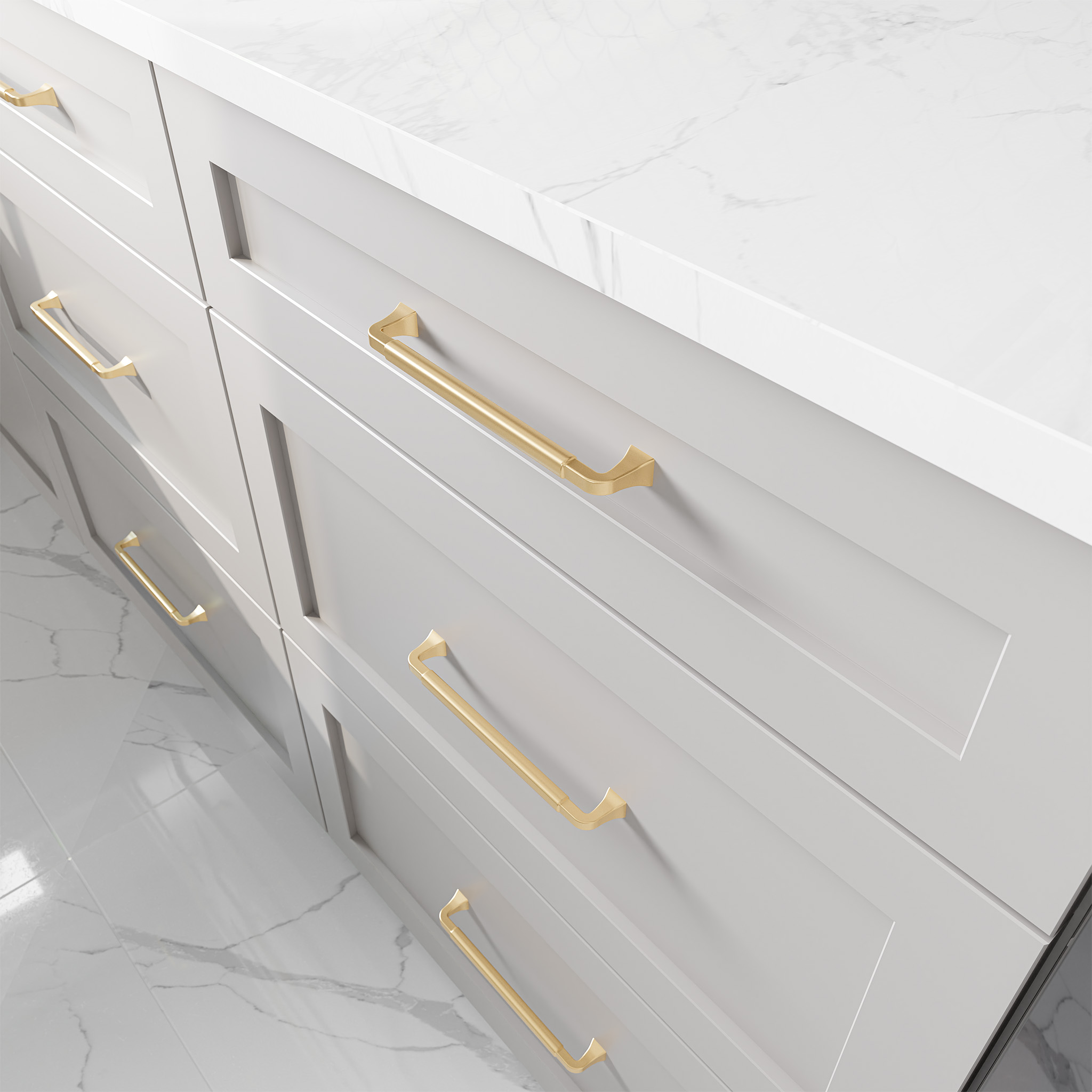
Drawers
Centre the knob or pull on the drawer front, both side to side and top to bottom. 2 exceptions are common:
- Shallow top drawers under about 120 mm tall: keep the hardware centred, or nudge it a few millimetres above centre so it clears the countertop lip and the hand does not brush the counter.
- Deep drawers, 200 mm and taller: place the hardware on the upper third of the front, or centre it on the upper rail if the drawer face has a frame. A pull at the true centre of a deep drawer sits low for an adult standing at the counter.
Where a bank of drawers has different heights, line up the hardware on a single vertical line down the stack. Lined-up hardware is what makes a run of drawers look ordered.
Wide drawers
A single pull on a wide drawer looks small and makes the drawer pull unevenly. Once the front is wider than about 600 mm, use 2 knobs or 2 pulls. Place each one about 1/6 of the drawer width in from the side edge, or centre each in the left and right halves. A pot drawer 900 mm wide, for instance, takes 2 pulls centred roughly 150 mm from each end.
The alternative is a single long pull of 256 mm or 320 mm centre-to-centre, which suits slab-front and contemporary kitchens.
Quick reference
| Location | Position |
|---|---|
| Upper cabinet door | Lower corner, opposite the hinge, 60 to 75 mm in from the bottom and side |
| Base cabinet door | Upper corner, opposite the hinge, 60 to 75 mm in from the top and side |
| Tall door | Opposite the hinge, about 1,000 to 1,100 mm above the floor |
| Drawer up to 600 mm wide | Centred |
| Drawer over 600 mm wide | 2 knobs or pulls, each about 1/6 of the width in from the side, or 1 long pull |
| Deep drawer | Upper third of the drawer front |
Keeping it consistent
- Decide the offsets once and use them on every door and drawer in the kitchen.
- Use a drilling jig so the holes land in the same spot each time; a scrap of plywood with 2 holes at your chosen positions works for the whole job.
- Tape a knob or pull in place on 1 upper door, 1 base door and 1 drawer, then open them a few times before drilling the rest.
- Drill from the face side with a sharp 4.5 or 5 mm bit, backed with scrap wood so the paint does not chip as the bit exits.